

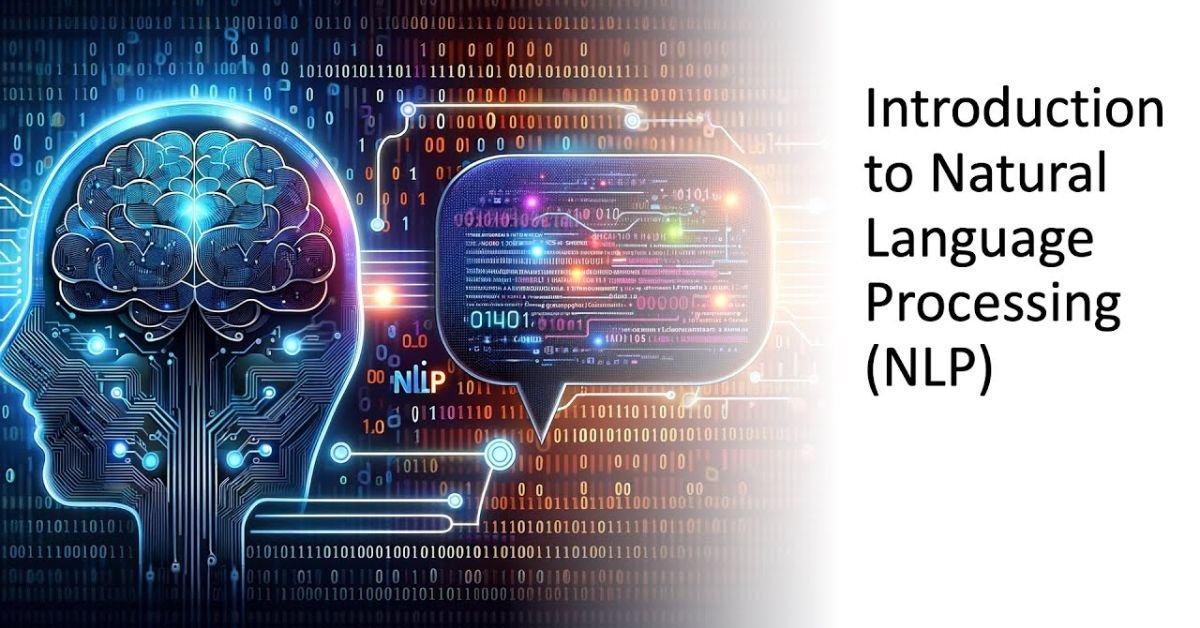
Using language to talk to each other has become a part of how we live. We send texts check emails ask questions and look things up on the internet or our phones all the time. For us humans making sense of this kind of information is usually pretty easy.. Can a computer do the same thing? Can it understand language the way we do?
Processing and interpreting natural language is not innate when it comes to computers. That’s where Natural Language Processing (NLP) comes into play!Natural Language Processing (or NLP), is a branch of artificial intelligence that studies how computers interact with people through various forms of language. This technology empowers machines to read, understand, and respond to human communication – whether in writing or spoken word.
And you may have already used several examples of NLP throughout your day! Search engines, voice assistants such as Siri or Alexa, spam filters, Google Translate… there are many more applications powered by this exciting tech which keeps gaining ground in terms of popularity and importance.
What Is Natural Language Processing (NLP)?
NLP (Natural Language Processing) includes using different algorithms allowing the computer to process and accomplish some tasks regarding this data. This technology can be implemented in case of working with either written or oral texts. During such processing, the algorithm breaks down the structure of the initial text/speech and derives its meaning. In general, NLP aims at facilitating and optimizing the interaction between computers and people. Computers always work in terms of binary codes. There are many challenges related to handling natural languages due to their different contexts where they occur.
But NLP helps bring computers closer to people since it allows them to know exactly what a particular word implies. Thus, a computer better understands all the necessary details and extracts only those pieces of information that are significant for the user’s request. For example, if someone enters an appropriate query into the search engine, the program does not try to find the same words as ones typed out but tries to grasp the idea behind it and deliver appropriate results according to what was inputted. So we get another way to apply the technology – NLP.
How Does Natural Language Processing Work?
There are several NLP steps involved here. Also, there’s a range of algorithms available to assist the computer in performing specific tasks. At the start of this process, the input text will typically have been broken down into smaller segments—these could be individual words, groups of words, or even whole sentences.When you’ve done that, the algorithm analyzes your data to find any identifiable patterns. For example, it might identify some specific words or phrases, work out their meanings, or figure out where you used them.
As a result, it could give you an insight as to how your input may be classified – or what sentiment underlies it.That’s just scratching the surface when it comes to what computers are now capable of thanks to advances in natural language processing technology. In addition to doing all those things listed above, they can translate your content from one language to another or identify certain entities.
| Step | What Happens |
| Input | The system receives text or speech |
| Processing | Language is broken into useful parts |
| Analysis | Words, patterns, and context are examined |
| Understanding | The system works out the possible meaning |
| Output | A result, answer, or action is produced |
Why is NLP Important?
Another reason why NLP is important is that there’s an abundance of textual data out there. Emails, articles, letters, surveys, social media, and other types of documents hold useful information.In conclusion, manually compiling and analyzing all these bits of info would be incredibly tedious! Natural Language Processing (NLP) does just that – processes all this stuff much more rapidly than we’re able to.
Say you wanted to find out how your customers feel about one of your products based on their reviews? With NLP, you could quickly get that analysis done for you.Thanks, to NLP people can talk to computers and try to remember complicated commands. NLP makes using programs much easier because people now have a way to tell computers what people want computers to do.
Main Components of NLP

There are different components in natural language processing that help break down communication the way humans do. As per application, different components are applied to specific situations. These components are essential in making computers and robots communicate like humans
The components include:
Natural language understanding:This component focuses on giving meaning to the language.
Natural language generation: This one is meant to make the computer generate language like a human.
Speech recognition: This component deals with recognizing and converting spoken language into written words or phrases.
Sentiment analysis: This is used to detect whether the input of language is positive, negative, or neutral.
Text classification. This component organizes the data into categories.
Language translation. The computer will translate the input language into another language.
Common NLP Techniques
Several techniques have been developed for use within NLP. These include some methods that are quite complex while others are just basic algorithms depending on the usage. Some techniques are described below:
Tokenization – It breaks up the text into smaller bits known as Tokens. Here the text can be in the form of sentences or words.
Sentiment Analysis – In this, we determine sentiments that are expressed through the given input texts. For instance, businesses use this method in order to get insights about customer feedback. Companies may collect data regarding how customers feel about their products.
Named Entity Recognition (NER) – As its name indicates, it detects entities such as names of people or companies, dates and even certain specified words in the text.
Text Classification – Here we categorize the input text. Spam classification is a good example where computers can detect if there is spam in an email based on certain features.
Real-World Applications of NLP
| Application | How NLP Is Used |
| Chatbots | Understand questions and provide responses |
| Search Engines | Interpret what users are searching for |
| Translation Tools | Convert language from one language to another |
| Voice Assistants | Understand spoken commands |
| Email Filters | Identify spam and unwanted messages |
| Customer Support | Analyze and respond to common questions |
| Reviews | Find opinions and customer sentiment |
Benefits of Natural Language Processing
NLP can be applied both in specific and broad ways. For example, it saves time, since the system can process much more text than a person. It can also help companies provide support to customers. For example, many inquiries can be handled by a chatbot, and those that require special attention, transfer them to customer service representatives.
Moreover, it is a great tool for getting additional information, for example, for summarizing documents, translating text, or optimizing searches. However, the quality of processing always depends on the input data and the software that processes it. Thus, NLP is a powerful but ultimately still a tool.
Challenges of NLP
First, working with natural languages is difficult for artificial intelligence because the same word might have multiple meanings depending on the context. Second, people often use slang, slang, sarcasm, omissions, and other types of abbreviations that a computer may have difficulty understanding. Third, a computer will not be able to completely understand the importance and context of a conversation.
Humans quickly identify when someone is being sarcastic or ironic, but all a computer sees is a collection of words arranged in some particular order. Fourth, systems tend to commit mistakes during the process of unnatural language, low quality texts, or texts in a language AI doesn’t know very well. Lastly, there could be issues related to privacy when we are talking about processing personal data, texts, or voice info.As you see, NLP encounters lots of challenges while studying the natural languages which fall under the umbrella of human logic.
NLP in Everyday Life

Maybe you wonder if you have ever used NLP? Maybe you think that NLP has no place in your daily activity? That is completely wrong!NLP today has a wide range of applications. It can be used for simple tasks or sophisticated problems. Even non-techy users are already interacting with NLP technologies because they are embedded into our daily devices.
For example, when we want to convert speech to text while we’re typing something on the phone, we are interacting with an element of NLP. Another way NLP is applied is in situations where emails need to be filtered out (unsolicited emails).Even translation programs, like translating a text written in another language, make use of NLP algorithms. Also, the predictive texts appear on our screen as we are typing out messages and when we search the internet – these are powered by NLP!
What Is the Future of NLP?
The road ahead for NLP looks bright as these algorithms will soon have the capacity to decipher more intricate linguistic riddles than ever before.Not only will they be capable of reading through our words, but also of grasping their meaning and comprehending them properly. So much so that this technology could easily evolve into an all-encompassing tool that can be used in every imaginable aspect of human existence from education and healthcare, to everything else in between.
So long as we can rely on its accuracy, NLP would make things such as customer service far easier to execute, as well as chatting with your voice assistant and interacting with chatbots. Yet even the most sophisticated of these algorithms may never hope to rival the complexities involved in communicating via actual spoken word.
FAQs
What is NLP in simple words?
NLP means Natural Language Processing. It is an area of artificial intelligence. Its main job is to work with human language. That includes understanding what people write or say.
Where is NLP used?
NLP helps chatbots talk to people. It is also used for text mining. Search engines use it to find the best pages. Speech systems use it to understand spoken words. Email filters rely on it to spot spam. It is used in customer service to handle user questions.
Is NLP a part of artificial intelligence?
Natural Language Processing (NLP) is a subfield of artificial intelligence (AI) that deals with the interaction between computers and human languages.
How does NLP understand human language?
NLP processes and filters input data, looking for patterns or context that helps the system to understand the language.
What are some examples of NLP?
Chatbots and virtual assistants, spam detection, text translation, and search engines are typical examples of NLP applications.
Conclusion
NLP helps computers work with what people say and write. It turns everyday language into something a computer can use. It can handle things like typed text and spoken audio. It spots patterns in what people say or write. It also pulls out meaning from that input. Then it can generate answers that fit the context. You see it in search tools and in chatbots you use day to day.
NLP is not perfect. It still has limits in what it can do. Even so, the system keeps getting better over time. As this area improves, computers may better catch how people communicate. That could help users talk to digital tools in ways that feel simpler and quic.

Wellcome to growthwavexpro im Dr.sahil an Ai-powered SEO.and content writer with 3 years of experience.
i help websites rank higer.grow traffic .and look amazing.my goal is to make SEO and web design simple and effective for everyone.lets achieve more together