


Machine learning is basically a part of artificial intelligence that helps computers learn from data. Instead of sticking to only rigid instructions, the machine can tease out patterns ,and then get better at its results as time goes on, you know.
Have you ever asked yourself how Netflix suggests movies, or how your phone hears your voice and understands it? Those are everyday examples of machine learning and they’re already running in the background of lots of apps and services you use every dayThere are times when you notice it, and there are times when you don’t.
In this beginner’s guide, you will go through how machine learning works , its main types, the benefits, the annoying challenges too, and where it shows up in real life. You’ll also see a clear path for beginners who want to start learning machine learning in 2026, step by step, without the confusion overload .
What Is Machine Learning?
Machine learning is kind of a slice of artificial intelligence , where computers can learn from data and get better at doing what they need , without someone hand programming every single task
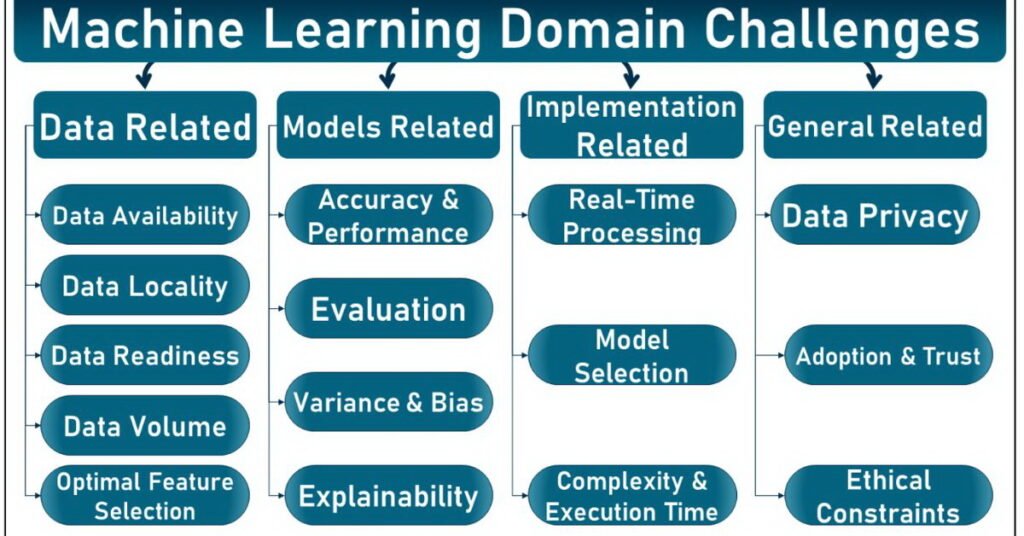
| Challenge | Description |
| Data Quality | Poor or kinda incomplete data can end up giving inaccurate results, not always but often enough, because the evidence is shaky, or, you know, less precise than it should be. |
| High Computing Costs | Advanced machine learning models may require powerful hardware and high processing costs.Advanced machine learning models might need strong hardware and quite high processing costs too. |
| Bias in Data | Biased training data can lead to unfair, or kinda unreliable predictions too, and the model might start judging in a skewed manner , even when you expect it to be neutral . |
| Lack of Transparency | Some complex models are kinda hard to grasp, and also difficult to explain. |
| Privacy Concerns | If you use personal data it can create a bunch of privacy and security risks , you know and it might get messy over time, like people can end up exposed more than they expected. |
| Incorrect Predictions | Machine learning models can still slip up, especially when they get data that’s kinda weird, low quality, or just not at all usual. Sometimes it’s like the model can’t really generalize what it’s seeing, and then it makes the wrong call. |
Real-World Applications of Machine Learning
Machine learning is used in a lot of everyday things, kinda in quiet ways. Like streaming platforms use it so you get movie and show suggestions , based on what you tend to watch. Online stores also use it to “nudge” you toward products , tied to your interests. Banks rely on it to spot suspicious transactions , the kind that look off. And email services use it to identify spam and harmful messages, pretty much on the fly.
Also, machine learning is reshaping healthcare, transportation, education , and business. It can help doctors sift through medical data, help with self-driving technology, tune lessons to the student, and even forecast business trends. In general these uses make systems run quicker and feel more capable , so they end up being more useful in real world situations.
Popular Machine Learning Tools and Technologies in 2026each time. It relies on learning procedures or algorithms to spot patterns, guess outcomes, and give a kind of support for smarter choices.
Like, Netflix uses it so it can suggest movies, email services can flag spam, and smartphones can recognize faces or voices. As the whole system keeps getting more useful information, it often ends up improving at its specific job too.
Types of Machine Learning
Supervised Learning
Supervised learning uses labeled data to sort of help a machine figure out predictions or decisions. You know, like it gets shown examples with the “right answer” already there, so it can learn from that pattern. For instance, it may learn to decide whether an email is spam or not.
Unsupervised Learning
Unsupervised learning works with data that has no labels, it kind of digs around and discovers hidden patterns in it, it also sort of groups things or finds connections in the observations. Instead of being handed the right answers upfront, it just tries to work stuff out on its own, kinda like a quiet sleuth, noticing any kind of pattern , where it wasn’t really that noticeable before.
Reinforcement Learning
Reinforcement learning sort of trains a machine through rewards and penalties , and it kind of steers what comes next. The setup learns by testing a range of actions at once, then it tends to gravitate toward the ones that lead to more favorable results, like you might notice in robotics , or even in games. In other words, it keeps experimenting , then it gets encouraged or held back depending on what it does.
Challenges and Limitations of Machine Learning
Machine learning is easy to develop thanks to libraries, frameworks, cloud computing platforms, and AI tools. In 2026, both newbies and experienced developers will be able to pick among various tools based on their needs and the type of data they wish to deal with.
Python
Python is among the most widely used programming languages in machine learning.It has a pretty easy syntax and it kind of comes with a huge number of libraries for data analysis, data visualization, machine learning, and deep learning as well.
Python is often picked by beginners because it feels not just simple to learn versus a lot of other programming languages but also familiar, somehow. Plus it works really well with machine learning toolkits like scikit-learn, TensorFlow, PyTorch, Pandas and NumPy, in general.
Scikit-Learn
Scikit-learn is a pretty well known library in the world of machine learning , it’s often used for sort of practical stuff and not just theory. You can use it to do all sorts of things around classification, regression, and clustering, plus data preprocessing, model selection, and a bunch of other machine learning work, in general. It’s kind of one of those tools people return to again and again, because it’s so practical.
The great thing about scikit-learn is that it is easy to comprehend and use by beginners, as well as for predicting prices, classifying emails, etc.
TensorFlow
TensorFlow is an open-source machine learning library that helps in creating various models and training them. The software is mostly used in deep learning and large scale machine learning tasks.
The developers can apply TensorFlow to handle image-based data, text-based data, speech, recommendations, and other data.
PyTorch
PyTorch is another widely used deep learning framework.It’s known for its flexibility , and is often used for study work, computer vision tasks , natural language processing, and some advanced AI applications too.
PyTorch lets developers shape neural networks and test out different model styles. Plus, it is handy when developers really want extra command over the training process , like tuning choices and stuff.
Keras
Keras is kind of an advanced deep learning library ,but it’s really meant to make the building of neural networks feel simpler. Since the design is fairly straightforward ,it can be a good pick for people who want to understand deep learning more, but don’t want to get overwhelmed by too much complexity or extra steps.
You can use Keras for image classification ,natural language processing, for predictions ,and also for other machine learning tasks and use cases.
XGBoost
The XGBoost is a pretty efficient machine learning tool , it runs on gradient boosting from decision trees and it kinda learns in stages, not just one pass .
It can be applied in both classification and regression tasks. The tool can be effectively used by organizations in making predictions on customers’ behavior or identifying potential risks.
Hugging Face Transformers
Hugging Face offers tools as well as pretrained models to be utilized in current AI and machine learning applications.Hugging Face Transformers are often used for natural language processing, but they can be put to work for other AI related things too.
Instead of building every single model from scratch, some developers might take pretrained models and then nudge them a bit, in order to line up better with their own particular needs.
Pandas and NumPy
Pandas and numpy are pretty much some of the most used libraries in the Python programming language, especially when you’re working with data, day to day it kind of depends but you get the idea.. Numpy is the library that helps do fast numerical computations, while pandas help with structuring, refining, cleaning, filtering and analyzing that data, a bit like a Swiss army thing for datasets.
And when you want to train a machine learning algorithm, you kinda need to have your data prepared first , whether it is for features, labels, or those little quirks in the table.
Jupyter Notebook
In Jupyter Notebook, you can use Python to generate code and results, as well as draw diagrams and add documentation in a single space.
This software has been widely accepted by beginners, researchers, and students since the user is allowed to execute code in steps and experiment on datasets and machine learning models.
Google Colab
Google Colab is a web application which enables users to execute Python and machine learning scripts without the need to set up a development environment on their computers.
It is especially helpful for individuals who are new to machine learning and would like to experiment with it. It also offers computing power that can be helpful with some machine learning tasks.
MLflow
MLflow is a framework used to manage the development process of machine learning. MLflow may be used to track experiments, manage models and control the various stages of machine learning projects.
It comes into play especially where the project has several experiments and models. The tool assists the developer in tracking the model and settings that yield certain results.
Cloud Machine Learning Platforms
The cloud platform is a source of computing power and services for creating, training, and deploying ML models. The use of such platforms may be necessary if there is not enough computational capacity on local computers for a specific task.
There are many cloud platforms used today.Some examples that people usually mention as the most popular cloud ecosystems include Google Cloud, Microsoft Azure , and Amazon Web Services (AWS).
How to Build Your First Machine Learning Project
Choose a Simple Problem
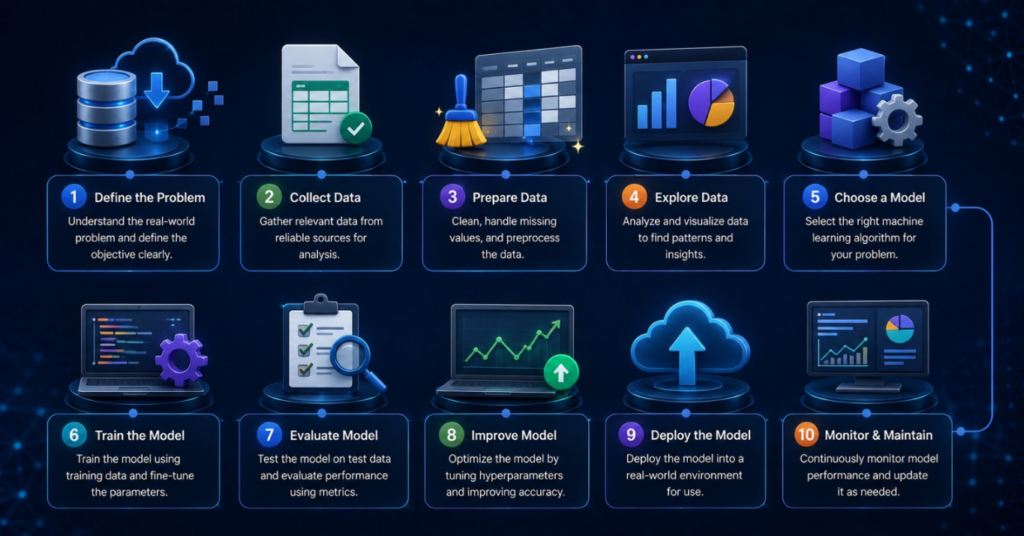
To begin, select a problem with a clear objective and some data. For instance, there is a project trying to guess whether students are passing or failing, based on their study hours, the attendance they bring , and their earlier grades.
The goal has to be very specific and also, well measurable.Do not say “My aim is to develop an AI project.” Rather, state your objective as, “My objective is to predict student performance using basic academic data.”
Collect the Data
Data forms the basis of all machine learning projects. The data can be gathered from any public sources, spreadsheets, web sites, APIs, and even your personal records when necessary.
If you’re working on predicting student success, your dataset may consist of data such as study time, attendance, prior performance, and final grades. Just make sure that the data is relevant and reasonably accurate for the given problem.
Clean and Prepare the Data
In real life data, you will often see missing bits, duplicated rows, awkward entries, or even redundant columns . Before you run the model, you should do some data clean up, sort of. This part usually includes removing duplicates, dealing with the missing values , converting the fields into numeric form, and choosing the more useful features (the relevant ones) .
Sometimes you have to make sure the data is consistent too, so the model does not get confused.Proper data preparation plays a vital role in producing a good model.
Split the Dataset
Once the data is prepared, it must be divided into different sections for training and testing. In the training section, the model learns a lot, and in the testing section, the performance is assessed with new information that it wasn’t trained on, not really.
Usually 80 percent of the data is used for the training part, while 20 percent goes to testing.
Select a Machine Learning Algorithm
Selecting an algorithm depends on the nature of the problem. For instance, linear regression is good for predicting numeric quantities, whereas logistic regression is good for classification problems.
Newbies can also start by trying out algorithms like decision trees, random forest, and k-nearest neighbor. The idea is to start with a basic algorithm so that its working is easily understood.
Train Your Model
It is now time to train the model with the help of your training dataset. In this phase, the machine learning algorithm tries to identify patterns and correlations within the data.
A student performance prediction model might identify correlations between the number of hours studied by a student and their attendance with the final grade obtained.
Test and Evaluate the Model
After the training process is completed, it’s time to run the model with the testing data . You know, once everything’s done, we go ahead and evaluate it on the test set, sort of straightforward, but still important, right.. That allows understanding whether it is capable of making accurate predictions based on new data.
This depends on the nature of the project, since there are different methods of evaluating the efficiency of classification projects and there are different ways to evaluate the efficiency of regression projects.
Improve the Model
Your first model might not come out amazing, and honestly that is completely normal. You can make it better by using higher-quality data , picking more useful features, tweaking model settings a bit , or even trying a different algorithm all together.
That said, don’t just chase a huge score. A decent machine learning model should do well on new, unseen data, not only repeating what it already saw in training and sort of memorizing it .
Save and Deploy the Model
After your model works well, you can store it and integrate it with an application that is simple. For instance, the website can take in values regarding the number of study hours and attendance, and give back the outcome.
Deployment will transform your machine learning experiment into a tool that can actually be used in the real world. If you are new to this field, you can begin with a simple web application.
Document Your Project
Finally, write down what you put together and roughly how it behaves. Like, not just “it works”, but what problem you tackled, the dataset you used, which features you fed in, what learning approach you picked, how you trained it, what results you got, and where it can break or be weaker.
Good documentation will make the whole thing easier to understand, and also work as a solid portfolio asset. If you study machine learning to build a career in this sphere, several good documented beginner projects will prove your practical skills.
Is Machine Learning Difficult for Beginners?
Although machine learning may appear complicated due to the existence of some new ideas like algorithms, data, models, and programming, it is possible to learn it in steps without necessarily having a comprehensive understanding of all aspects at the very beginning. This can be achieved through using simple Python, mathematics, and projects while learning.
It is not necessary to be a mathematics or programming expert before embarking on the process of machine learning. It will be important to understand how data is collected, learned by the model, and predictions are made.By doing constant practice and working on a few simple projects, you can push your machine learning know-how forward. It’s kinda a steady thing, not instant but if you keep going, you learn more and more, little by little.
FAQs
What is the best programming language for Machine Learning?
Honestly, one of the best languages for beginner coders to use is Python, because it feels pretty straightforward to learn and there are a lot of machine learning libraries out there so it kind of gives you support for a wide variety of tasks right away.
Which Machine Learning tool is best for beginners?
However , Scikit-learn can be seen as a really solid first choice, because it ’s simple and it provides plenty of ability for classification , regression and clustering, kinda like a clean starting point.
What is PyTorch used for?
PyTorch is getting used for developing and training neural networks, for computer vision, natural language processing and artificial intelligence research, basically. It helps people build models and run learning sessions, on tasks that are pretty varied, in practice.
Why are Pandas and NumPy important in Machine Learning?
NumPy sort of helps with the calculations , while Pandas tends to be better for sorting and tidying up data before you start training a model, or something similar.
Do beginners need to learn all Machine Learning tools?
No , not really. I mean like a beginner can get started with Python, NumPy, Pandas, and scikit-learn first, and then after that you kinda drift toward more advanced stuff , such as PyTorch or TensorFlow later. Because it’s like you set up the foundations first before you touch the heavy lifting, you know… not immediately though.
Conclusion
Machine learning plays a pretty important role in today’s world of tech, you know, it kind of sits right there in a lot of the systems we use, and yeah it matters more and more. It is responsible for assisting the computer to learn from data and discover useful patterns that can be used to predict something useful.
In all kinds of fields from recommendations to healthcare and businesses, the usage of machine learning is increasing rapidly.Machine learning might seem difficult to learn at first especially for the beginners but using python and some basic resources can help a lot in making this process much easier.

Wellcome to growthwavexpro im Dr.sahil an Ai-powered SEO.and content writer with 3 years of experience.
i help websites rank higer.grow traffic .and look amazing.my goal is to make SEO and web design simple and effective for everyone.lets achieve more together