

Artificial Intelligence AI) is a kind of technology that lets computers and machines do tasks that usually need human intelligence, not just simple stuff. These tasks might involve learning, figuring things out, understanding language, and even making choices. Artificial intelligence is, like, really showing up in our daily routines now. We’re basically using that intelligence every single day, even if we don’t notice. And it’s quietly changing how we do things in general.
What about a phone that unlocks with your face, a virtual assistant that answers questions, or a movie suggestion that feels weirdly on point? Yeah, these are all examples of artificial intelligence working in real time. AI is changing the way people work, study , shop, and communicate across the whole world.
This beginner guide is meant to explain what Artificial Intelligence (AI) is, how it works, its different types , and the benefits. It also covers real-life uses and the future chances we might see next. By the end of this guide, you should have a solid picture of AI, and why it’s one of the most important technologies in 2026..
What Is Artificial Intelligence?
Artificial Intelligence (AI) is a modern type of technology that helps computers and machines sort of “ think ” learn, and do tasks in ways that look like humans. Rather than sticking to only fixed rules, AI can digest data, notice patterns, make sense of language, spot images, and come to judgments using what it gets. Because of that, these systems can become a bit more capable, and often more accurate, as time goes on.
AI is now around daily life, even if a lot of people don’t really pay attention. You can find it in voice assistants, search engines, online shopping, social networks, navigation apps, spam filters and customer service chatbots. Quite a few companies use AI too, for better services, fewer mistakes, and to save time, also.
How Does Artificial Intelligence Work?
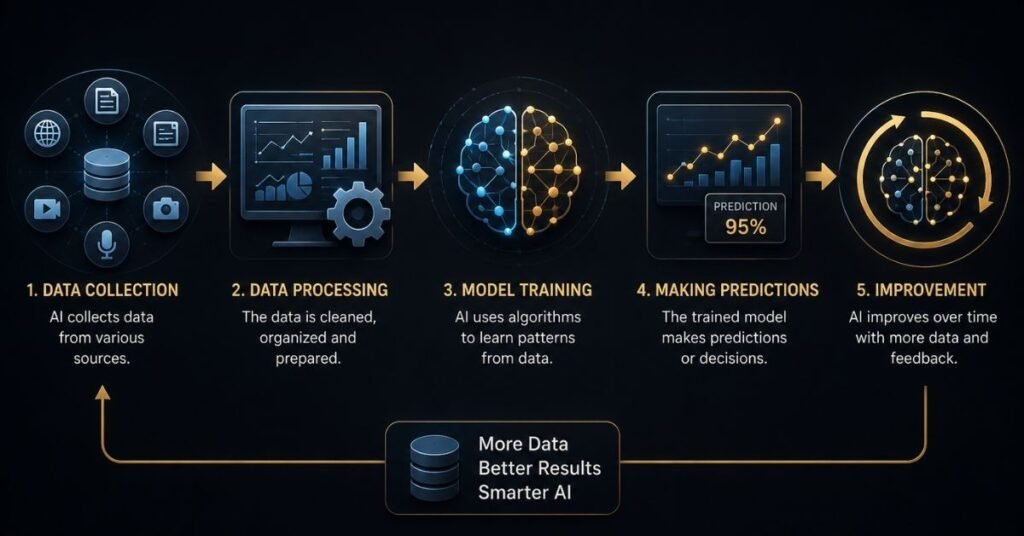
Large streams of data are collected and then examined by Artificial Intelligence, but also, kind of, reviewed again and again. It uses algorithms and machine learning to sense patterns, understand intent, and, at the end, choose actions. The more data an AI system takes in, the better it gets at learning, and adjusting its outcomes little by little as time passes.
When a user hands AI a task , like asking a question or uploading an image, the system processes that information and then matches it against what it has already learned earlier. After that, it gives the most accurate answer, or it carries out the requested job. This whole workflow helps AI drive voice assistants, suggestion engines, chatbots, translation tools, and lots of other smart applications that people use every day.
Types of Artificial Intelligence
Narrow AI (Weak AI)
Today, narrow AI is kind a the most common sort of Artificial Intelligence, and it probably is.. It is built to handle one specific task , and it can’t really step outside its programmed function. You can see this in voice assistants, chatbots, face recognition systems and recommendations on YouTube or Netflix . It tends to work fast and correctly, yet it does not reason or really grasp things the way a human does.
General AI (Strong AI)
General AI is a kind of Artificial Intelligence that is still being researched, kind of, as in its not fully there yet. People expect it to think, learn, understand, and also handle problems the way a human would. In contrast, Narrow AI is more limited, it can be built for a specific job, and it doesn’t really flex into totally different areas without extra work. Even though scientists are making real progress, General AI is, at this point, not created yet.
Super AI
Super AI is basically a theoretical form of Artificial Intelligence, that maybe would end up being more intelligent than humans across, nearly every field. It could take decisions, fix hard problems, and learn at a faster rate than people. Still, a few experts say Super AI could give plenty of benefits , but others worry it might cause serious risks if it is not guided properly. Right now, Super AI just does not exist, so it stays as a future idea and nothing more.
Limited Memory AI
Limited Memory AI can keep a few bits of past info for a short while, so it can make better decisions later on. This kind of AI is used a lot right now in self-driving cars, virtual assistants, and also in recommendation systems. it kinda learns from the recent data, and that helps it improve its overall work.
Theory of Mind AI
Theory of Mind AI is kinda a future, type of artificial intelligence that tries to get a handle on human feelings, what people think , and the intentions behind what they do. The idea is that it can converse with folks in a more natural and also sharper manner, not just with keywords but with a kind of real understanding. At the moment though, this tech is still being studied, in the research stage, and it isn’t ready for everyday use yet, at least not in any normal sense.
Self-Aware AI
Self-Aware AI counts as the most advanced and, honestly, more theoretical kind of artificial intelligence.In that case it would have its own sort of awareness, kind of thoughts, and a clear understanding of what’s going on around it. This kind of AI isn’t really around today, it still exists mostly as an idea , and it’s mainly the sort of thing researchers , scientists , tend to talk about, more or less, than anything else.
The Benefits of Artificial Intelligence
- Tasks are completed faster and time is saved.
- Accuracy is improved and human errors are reduced.
- Works 24/7 without getting tired.
- Automates repetitive and routine tasks.
- Makes data-driven decisions easier for people.
- Supports better patient care and faster diagnosis.
- Enhances customer service with AI chatbots.
- Reduces business costs and increases productivity.
Challenges and Limitations of Artificial Intelligence
| Challenge / Limitation | Explanation |
| High Development Cost | Building, training and maintaining these AI systems is kind of a big commitment, honestly you usually need a lot of investment, to make it keep going. |
| Job Displacement | AI can automate repetitive tasks, reducing the need for some human jobs. |
| Lack of Human Intelligence | AI can’t truly think or really reason , and it wont understand emotions the way humans do. It feels more like pattern matching, not that lived meaning people have inside. |
| Data Privacy and Security | AI systems tend to lean on huge amounts of data, and that can bring privacy and cybersecurity risks along with it. Sometimes it’s not just the data itself, but how it’s stored, shared, or reused later, which makes the situation kinda tricky. |
| Bias and Unfair Decisions | AI may create inaccurate or uneven results if it is trained on data that is biased , and you might not even notice it at first, you know. |
| Dependence on Quality Data | The artificial intelligence system works well when it has good data. This data needs to be accurate and complete. |
| Need for Regular Updates | AI systems need constant attention, upkeep, and a steady tuning, so they stay effective over time , because if you just let them sit there their performance can drift. In a more practical sense, this means regular checkups, small tweaks , and a bit of ongoing learning, not just once setup and then done. |
| Ethical and Legal Challenges | Using AI does raise worries around fairness, accountability, transparency, and legal responsibility , in a way that feels kind of tricky all at once. People also question who is accountable when things go wrong, what’s actually being shown (or kept hidden), and whether the whole process is truly clear enough for compliance. |
How AI Is Changing Different Industries
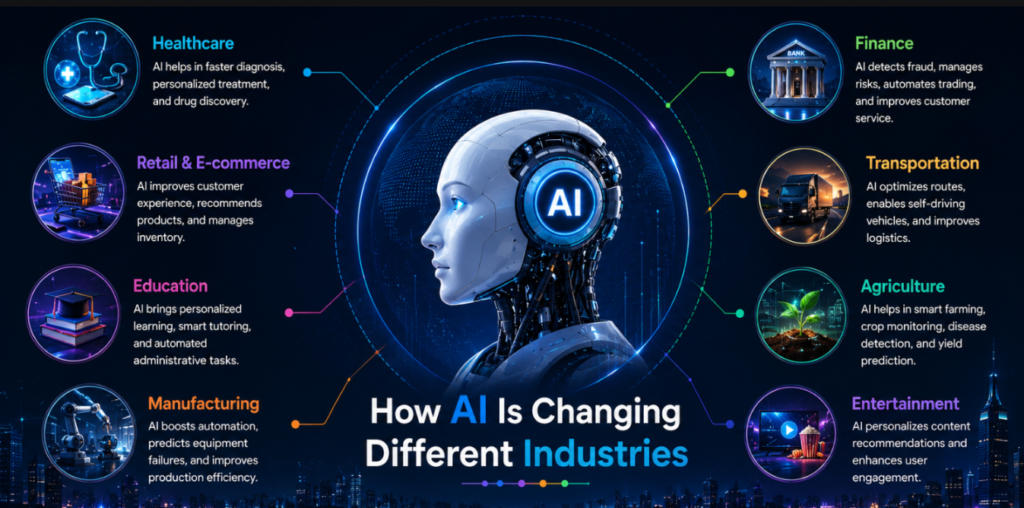
Artificial Intelligence is changing a lot of industries by helping work move quicker, with more clarity, and also more accurate outcomes. In practice it helps companies enhance their services, cut down costs, and make better choices by using data. You know, it also kind of makes processes smoother, and a bit less clunky overall.
AI in Healthcare
AI is, kinda improving healthcare now by helping doctors catch illnesses earlier, and they can give more suitable treatment. It can scan medical images, go through patient histories and test findings pretty fast, so there’s less waiting and it usually boosts precision.
AI also helps medical research along the way by spotting subtle patterns inside huge volumes of health information. Plus there are virtual assistants, wearable gadgets and even AI-driven robots that assist patients with smoother care, while cutting down the time and effort healthcare professionals would otherwise spend.
AI in Education
AI is making education kinda more personal and interactive for students, it can help match lessons to how fast someone learns, and it can adapt in a more responsive way. Some smart learning platforms adjust the content according to a student’s learning pace ,and they also give immediate feedback so understanding sticks better.
Teachers too are using AI ,not just for learning paths. They can automate grading, prepare learning resources, and monitor student progress. That means teachers get extra time for hands-on support, and the whole learning experience gets smoother, like more focused and less messy.
AI in Business
AI assists business teams in a way that feels kind of seamless, like the routine stuff just gets handled on its own. It can streamline those everyday operations, sharpen customer support, and interpret market signals more clearly. After that, companies end up making quicker decisions, cutting costs, and increasing throughput, even if nobody really changed the normal workflow too much.
A bunch of companies lean on AI powered chatbots so customer questions are answered 24/7, with less waiting.AI is also used for sales prediction, inventory direction, and individualized outreach ,which basically turns marketing into a more steady cadence. With all that going on , businesses tend to run smoother. They stay competitive too, because they can pivot faster than before.
AI in Banking
AI is making banking faster, safer, and honestly kinda more convenient, in a way. It helps banks catch fraud earlier, gives the go-ahead on loans, and interprets customer data with more precision than it used to be.
A bunch of banks use AI powered chatbots for customer support, like you know, so they can answer questions anytime. It also strengthens online banking protections by spotting odd patterns or suspicious actions, then shielding customer accounts from trouble.
AI in Transportation
AI is getting better at transportation, kind of making journeys safer and more efficient. You can really see it in self-driving cars , traffic control systems , and smart route apps, all of it to cut down on accidents , and also save time, which is, yeah, the big deal.
AI meanwhile helps logistics organizations with delivery routes planning, so they can waste less fuel, and manage the entire supply network operation more smoothly. In the end this usually means faster drop-offs , plus smaller transport costs , overall, it all kind of stacks up.
AI in Entertainment
AI is kinda changing the entertainment industry, by crafting more personalized moments for users or whatever. Streaming platforms will often lean on AI to suggest movies, tv shows and music in a way that fits somebody’s tastes, not only general popular picks, you know.
And it does more too—AI is also tied into video game development, content creation, and special effects. Basically it helps creators to make better quality entertainment, while people get more interactive, and honestly more enjoyable experiences as well.
How to Learn Artificial Intelligence as a Beginner
AI systems need constant attention, upkeep, and a steady tuning, so they stay effective over time , because if you just let them sit there their performance can drift. In a more practical sense, this means regular checkups, small tweaks , and a bit of ongoing learning, not just once setup and then done.. If you focus on the basics then keep practicing often, and also do small easy tasks, like little experiments or a tiny model, beginners can slowly build up their AI knowhow. In time this becomes more fluent, and the whole thing feels less like a maze.
Learn AI Basics
First, see if you can get what Artificial Intelligence really is, not just the definition, but how it behaves, kind of a messy idea that still kinda holds together. Watch how it acts in practice, like what happens under the hood, step by step, even if it feels a bit tangled at first, because it usually is. Before you jump into the more advanced things, learn the core bits first: AI itself, then machine learning, deep learning, and also data science.. Try to link those topics together, because they’re tied up, in a relay, one moving into the next. After that you can move toward more complicated themes with a steadier grip , and less confusion.
Understand Machine Learning
Machine learning is a really important part of AI , mostly. Like basically it helps computers learn from data so they can notice patterns, do forecasts , and get better over time, even when you don’t have to write code for every single task, or anything like that.. It’s kind of like the system starts grasping what’s going on, from those examples , and then it turns that into more informed choices.
Practice with AI Tools
Try messing around with simple beginner friendly AI tools like ChatGPT , Google Gemini and Microsoft Copilot, to get a feel for how AI works in real life. Just play with them a little bit, you know , so you learn the basic features and not get overwhelmed. In practice it helps a lot with confidence too, and the whole thing feels more tangible.
Build Simple AI Projects
Honestly the best way to learn AI is to start with small projects and mess around a bit. Like you could cook up a quick chatbot, or an image classifier , and even a recommendation system if you want. Doing that kind of practical work helps you pick up the skills faster and also sharpen your problem-solving mindset , little by little.
Keep Learning with Online Resources
AI is changing really fast, so just keep learning through online courses, tutorials, books and videos. It’s kind of like staying awake, you know, check new AI technologies, try to stay current, and doing practice often too, not only theory. Over time, that steady routine will make you more skilled, in a way that is kinda practical, not just theory, and honestly it adds up.
Popular Artificial Intelligence Tools in 2026
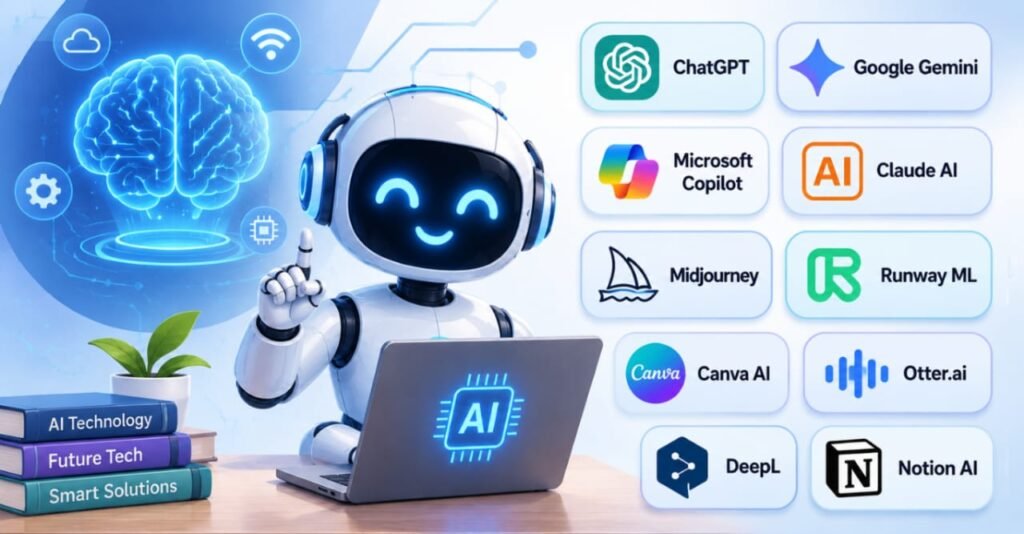
Artificial Intelligence tools have pretty much turned into a key part of day-to-day life, schooling, and business too. They help people with content making, image creation, data analysis, code generation, and general productivity boosting. By 2026, quite a lot of these AI tools are easier to use than before, and they’re made so both beginners and pros can jump in without too much trouble.
ChatGPT
ChatGPT is one of the most popular AI tools for writing, learning, coding, and answering questions, kind of.It helps users make content, trim information, handle troubles, and raise productivity with simple text prompts, not really with too much hassle.
Quite a few students, freelancers, and businesses lean on ChatGPT to save time, and get tasks done more efficiently, to be honest . It also comes in handy for generating ideas, swapping languages, and picking up new skills in an interactive way as well.
Google Gemini
Google Gemini is this powerful AI assistant made by Google. It can help people with research, writing, coding, and answering questions, using advanced AI tech and Googles huge knowledge base.
Gemini also connects with Google services like Gmail, Docs, and Drive , so it feels more convenient to finish everyday tasks. Many folks use it in education, for business, and for personal productivity stuff, basically in places where you want faster progress without so much effort.
Microsoft Copilot
Microsoft Copilot is this kind of AI assistant thing that works inside Microsoft Office apps like Word, Excel, PowerPoint , and Outlook. It basically helps you write, summarize, and come up with ideas while you’re working there, in a more fluid way than before.. It helps users write stuff, analyze numbers, build presentations, and handle emails with less friction, basically.
Copilot saves a lot of time by automating the repetitive chores and giving smart suggestions, you know. It’s pretty handy for professionals, students, and companies that use Microsoft products pretty often.
Claude AI
Claude AI is this intelligent kind of chatbot, made to deliver clear, detailed, and pretty useful answers. People use it a lot for writing stuff , trimming summaries of long documents, brainstorming ideas, and basically working through complicated problems.
What stands out is how Claude AI tends to craft responses that feel natural and easy on the brain to read, so it’s not just raw output. A lot of folks choose it for research, professional writing, and education, since the explanations come with that extra depth.
Canva AI
Canva AI kind of helps users make professional designs pretty quickly, even if they dont have advanced graphic design skills. It can come up with images, slides, social media posts, and marketing stuff using only simple text prompts, and yeah it feels more natural then you might think.
The same tool also has AI editing features that make the whole process faster , and a bit less stressful.It’s pretty popular with students , content creators, marketers and also small business owners, you know.
Future of Artificial Intelligence
The future of Artificial Intelligence is looking really good, like, genuinely. There are so many things Artificial Intelligence can do , it’s kinda wild.People expect AI to get smarter faster, and a bit more handy in daily life. It’s supposed to keep improving a bunch of industries like healthcare, education, business, transportation, and entertainment, by dealing with tricky problems, and making things run more efficiently.
In the coming years, AI will operate more closely with humans, instead of replacing them completely. It’s thought to open new job opportunities, help scientific research move along, and make daily tasks feel lighter through advanced automation.And as AI keeps growing governments and organizations will pay more attention to the ethical use, privacy , and security side of things, so the pros reach out to everyone and somehow benefits spread wider .
FAQs
Artificial Intelligence: why is it important?
AI helps improve productivity, it saves time, cuts down on errors, and supports better decision making across many industries. Sometimes it also makes things feel a bit more streamlined, more steadier, but overall yeah it’s doing the heavy lifting..
AI in the workplace: where does it fit?
AI helps improve productivity, it saves time, cuts down on errors, and supports better decision making across many industries. Sometimes it also makes things feel a bit more streamlined, more steadier, but overall yeah it’s doing the heavy lifting.
Is Artificial Intelligence easy to learn for beginners?
Yes, beginners can learn AI by grasping the fundamentals, practice with AI tools a bit, then, make small projects, maybe. Also taking online courses helps a lot, because it adds a step by step vibe and keeps you from getting stuck.
Will Artificial Intelligence replace human jobs?
AI might automate a few routine gigs, but honestly it will also bring in fresh job opportunities which means people can use their human creativity and technical skills. In other words it could replace some tasks, and at the same time opens up other roles, like something more inventive and precise, so humans still matter in a practical way.
Is Artificial Intelligence safe to use?
Yes, Artificial Intelligence is often safe when its used responsibly, with proper security and privacy protection and also some ethical rules . People usually forget that, but if you do it right then it tends to work well , and nothing goes too far.
Conclusion
Artificial Intelligence is kind of reshaping how folks live, work, and learn. It helps save time , boosts accuracy, and tackles problems across lots of fields like healthcare, education, business, and transportation. As AI technology keeps growing, it will likely become even more essential in our everyday lives, sort of quietly but a lot.
Learning Artificial Intelligence is pretty valuable, for what comes next, and honestly it helps to know the basics first. Newcomers can start with the fundamentals, maybe mess around with AI tools , and build some small projects too, so the understanding actually sinks in a bit more.. If people and businesses use AI responsibly , and keep going with study, they can tap into the many chances this technology has to offer.

Wellcome to growthwavexpro im Dr.sahil an Ai-powered SEO.and content writer with 3 years of experience.
i help websites rank higer.grow traffic .and look amazing.my goal is to make SEO and web design simple and effective for everyone.lets achieve more together