
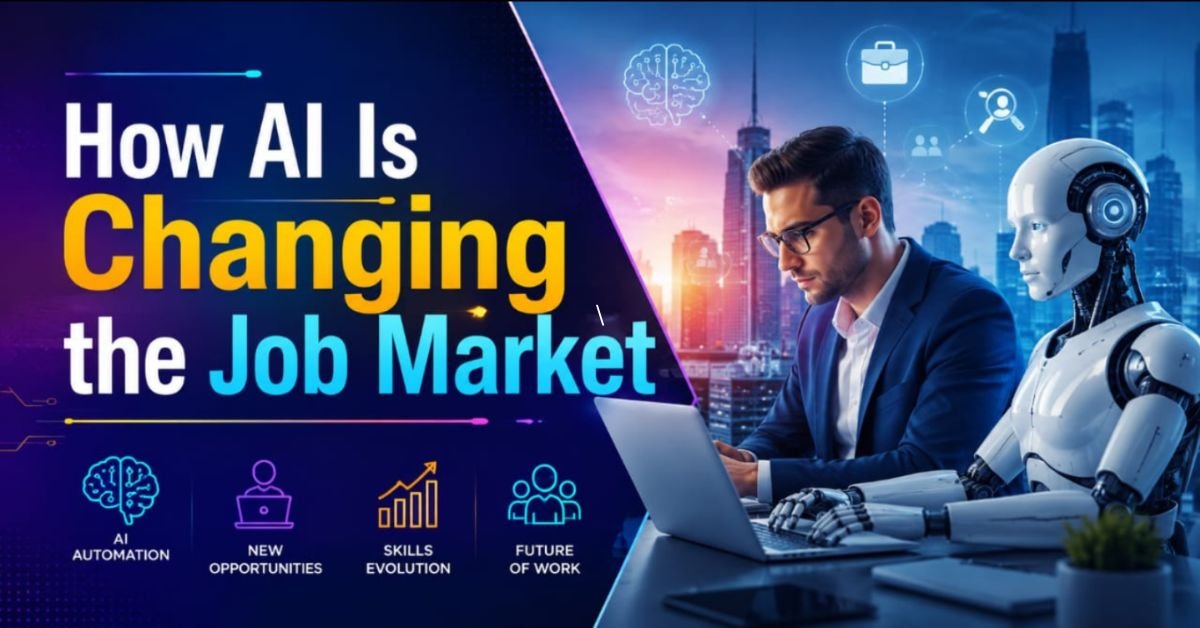
Artificial intelligence (AI) is really starting to shift how people work, and also how businesses choose who to hire. The reason it matters is because How AI Is Changing the Job Market, is basically about the ways AI affects jobs, day to day work tasks, the skills that seem necessary, and the kinds of career openings that show up.
AI is moving into a lot of workplaces now. It can handle repetitive chores, sort through information, and assist workers so they can reclaim time. Because of that, this change is opening up some brand new opportunities while at the same time it is reshaping certain traditional positions, kind of quietly at first.
In this article, we’re going to sorta dig into how AI is shaking up different careers. Also we will look at which roles get hit the most by AI, what skillsets workers might need going forward, and how people can prepare themselves for what comes next, even if it feels a little uncertain, or kinda vague at times.
AI and the Changing Nature of Work
AI is kind of reshaping how work happens, because it can take over lots of repetitive and slow tasks. Employees can now use AI for organizing information, drafting some basic texts , getting into data, answering the usual questions, and finishing other routine activities quicker than before.
Still, that does not always mean the whole role gets replaced. Sometimes it s only specific parts of a job that get automated, and then people end up with extra bandwidth for more inventive thinking, clearer dialogue, better coordination, or even tackling problems that need human judgment. As AI shows up more and more, learning how to work alongside it, or how to use it well, is becoming an important piece in many careers not just some tidy option.
Jobs Most Affected by AI
Jobs that have repetitive, predictable, or very data driven tasks are more apt to see changes due to AI. Like customer service, data entry, basic writing, accounting, marketing, and a few technology related roles are already leaning on AI tools to speed up daily operations, or make stuff less slow.
Still, the impact of AI isn’t the same in every profession. Some positions might need fewer people for certain duties, while others may just shift what they do day to day. Work that leans hard on creativity, emotional insight, leadership, hands on physical effort, or multi step judgment calls can remain needing a strong human presence though.
| Job / Industry | How AI Is Affecting It |
| Customer Service | AI chatbots handle common questions and basic support. |
| Data Entry | AI automates repetitive data entry and organization. |
| Marketing | AI helps create content and analyze marketing campaigns. |
| Accounting | AI assists with calculations, records, and routine reports. |
| Software Development | AI supports coding, testing, and debugging tasks. |
New Career Opportunities Created by AI

Even if AI might reduce some chores, it’s also making brand new kinds of jobs. Businesses still need real people, to build AI systems, guide AI projects, sort through data, keep an eye on digital platforms, and make sure AI is being applied the right way not just the exciting way.
So, all of this brings opportunities for technical folks and for people who are not technical at all. Not everyone has to become an AI engineer, to benefit from these changes. If someone can really understand AI tools first, then learn how they slot in within a specific industry , it can open up fresh career paths, faster than you’d think.
How AI Is Improving Workplace Productivity
One of the biggest perks of AI is that it can kind of save time. An employee can use it to summarize a long document, line up information, make a first draft, do fast data analysis, or answer everyday customer questions, all within a short span, which is pretty quick honestly.
That also kinda means workers can lean toward more meaningful responsibilities.Instead of spending most of the day doing the same old chores, employees could get more room for thinking ahead, creativity, coordination, and even better customer relationship vibe. The best outcomes often show up when the AI takes care of the background grind, or the support work, while people still supervise it, guide it , and actually close the loop on the final deliverable.
Key Points :
- AI saves time on those daily tasks like, pretty much.
- AI helps employees work quicker, and also calmer.
- AI reduces repetitive work with ease ,really.
- AI improves workplace decision making and also better judgment, overall.
Skills Workers Need in the AI Era
As AI changes workplace responsibilities, employees need to build skills that help them use tech effectively or at least not get stuck. Having basic AI knowledge really matters, it helps people get the sense of what different tools can do, and also where their boundaries are, not just the shiny parts. In other words, understanding the capability and the limits can make day to day tasks less confusing.
Still, the human side stays very important. Critical thinking lets workers verify AI outputs, and creativity helps them craft original directions instead of copying what’s already there. Communication skills matter too, leadership , problem-solving , plus adaptability can keep people valuable even when technology changes the way their jobs are handled.
Benefits of AI for Employees and Businesses
AI can bring a boost to businesses, by making their processes faster and more efficient in a sort of smooth way. It can assist companies in interpreting information, upgrading customer support, lowering repetitive workloads, and even nudging employees through daily chores. In the end it might let businesses put more energy into growth, and creative breakthroughs rather than getting stuck in the day to day grind.
Employees can gain from these changes too, because AI can act like a practical helper, not just something abstract. It can support research, help with writing, help with organization, and take care of the more data heavy tasks. When workers get proper training , they can use AI to reclaim time and also raise the overall quality of their work. So instead of seeing it only as a threat, they can see it as a useful tool.
Challenges of AI in the Job Market

AI growth is also kind of a double sided thing, because it creates real challenges. Some businesses might automate tasks that used to need several employees, and that can hit certain positions pretty directly. At the same time, workers may feel pressure to ramp up learning new tools fast, especially when their industry starts moving around.
Then there is also the accuracy angle, and the responsible use part. AI systems can occasionally generate wrong outputs, or biased and sometimes even misleading information, even if it looks polished. Privacy and data security matter a lot too, not just the headlinesSo, in practice businesses should lay out clear guidelines, give real direction to employees, and keep human oversight while using AI because if not it gets kind of weird and risky.
How to Prepare for the Future of Work

Getting ready for an AI-driven job market doesn’t exactly mean you have to learn everything there is about artificial intelligence. Honestly, a more grounded path is to see how AI is already used in your own line of work, then pick up the relevant tools that can make daily tasks feel less heavy.
Also, ongoing learning helps when job duties shift around, because you can pivot faster. people can sharpen their digital skills, test out AI tools that actually match their field, and at the same time boost human strengths like clear communication, and problem-solving which still matters a lot. Staying curious and adaptable can be just as crucial as technical understanding, and sometimes it feels more important than people think.
Key Points :
- Try to pick up fresh skills on a regular basis, and don’t stop there.
- Work on getting better at your digital abilities, step by step little by little, so it adds up.
- Stay on top of the newest technology trends, always you know .
- Also , focus on building solid communication skills, clear and steady for real, yes that kind.
The Future of AI and Employment

The future of work is probably going to be about tighter cooperation between humans and AI. A few jobs already in place might shift around, and also, brand new roles could show up when companies find unusual ways to use technology. So in general, the workplace tomorrow might seem, a bit, unlike what we know today.
AI can be quite strong at handling huge quantities of data and finishing specific tasks fast, yet people supply qualities like empathy, imaginative thinking, judgment, and those on the ground experiences. Employees who figure out how to blend these human abilities with AI systems may end up more ready for upcoming chances, maybe even unexpected ones.
FAQs
Will AI replace human jobs?
AI might end up automating some tasks, but that doesn’t mean every job is just going to disappear. A lot of work roles are more likely to shift, as employees start using AI as a sort of support for their everyday responsibilities, kind of like a quiet assistant that shows up when you need it.
Which jobs are most affected by AI?
Jobs that involve repetitive, fairly predictable, and very data-heavy duties tend to be more vulnerable to automation , but it really hinges on what each role actually does day to day. And yeah, the industry also matters, because the real effect isn’t the same everywhere.
What skills are important in the AI era?
AI literacy, critical thinking, creativity, communication, problem-solving, and adaptability are important skills. Combining these abilities with industry knowledge can help workers remain competitive.
Is AI creating new jobs?
Yeah, AI is making new chances in places like AI development, data analysis , cybersecurity, automation, AI leadership, and technology consulting. At the same time it sort of brings extra duties inside roles we already have, like more responsibilities, and yeah it can shift what people actually do day to day.
How can workers prepare for AI?
Workers can find out how AI is actually being used in their industry, and they can practice with tools that are relevant. At the same time they should keep developing human abilities that AI cannot so easily replace ,like creativity, leadership, and communication. In other words, it’s not just about the algorithms, it’s about the person too, even if things change fast.
Conclusion
AI is kinda changing the whole job market—like, it’s automating the routine stuff, boosting productivity, and somehow opening new career pathways too.I mean yeah, some jobs might get shaken up, but a lot of them will also transform as technology becomes just like part of everyday work, you know.
Honestly, the most useful way to get ready is to keep learning and staying flexible, in a sort of practical way.People who build up AI know how along with strong human skills can actually use these tools to strengthen their careers, rather than just fretting about what it might do.

Wellcome to growthwavexpro im Dr.sahil an Ai-powered SEO.and content writer with 3 years of experience.
i help websites rank higer.grow traffic .and look amazing.my goal is to make SEO and web design simple and effective for everyone.lets achieve more together