

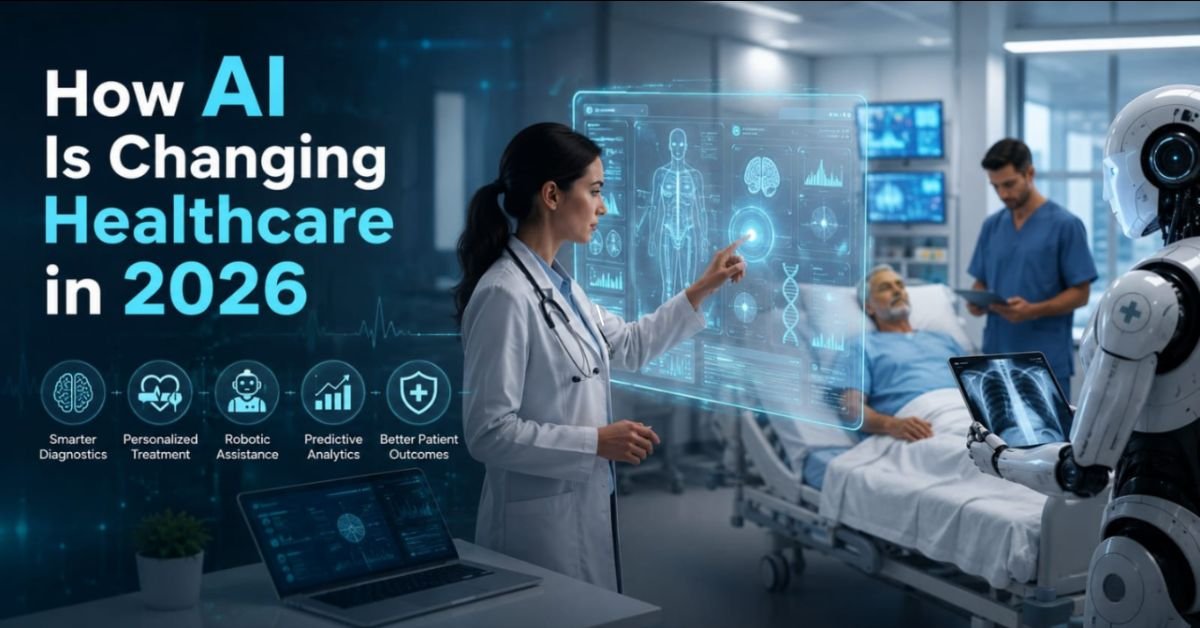
Healthcare has always been on people really, but technology is quietly changing the way care gets delivered. Lately, doctors and hospitals have access to tools that can process information in seconds and help with tasks that used to take quite a lot longer, like hours, honestly.
Artificial intelligence (AI) is one of those tech options. It can examine medical data, spot subtle trends, aid in diagnosis, and assist healthcare workers with day to day operations. By 2026, AI is showing up more often in hospitals, clinics, research centers ,and also in digital health services.
Even so, AI is not a real substitute for doctors. It does its best work when it brings along extra medical context for clinicians, and it saves them time , so they can focus. The final call still needs to stay with qualified healthcare practitioners, no shortcuts there.
What Is AI in Healthcare?
AI in healthcare is about computer systems that can learn from information, and then use that information to do tasks that usually need human reasoning. Sometimes, these tasks include spotting subtle patterns in medical images, sorting patient records, or supporting researchers as they dig into diseases.
This technology can deal with many kinds of data. Medical reports, scan results, lab information, and even signals from wearable devices may all help. And if everything is handled the right way, AI can give healthcare workers a more precise idea of what might be going on with a patient.
How AI Is Improving Patient Care

Good healthcare is not only about handling an illness, it’s also about making sure patients get the correct kind of attention at the right moment, you know. AI can lend a hand with some of the small yet important chores that happen in patient care.For instance, digital services can nudge patients about appointments or medicines.
A few of these tools can even help healthcare staff sort out patient records ahead of time before the consultation. This keeps things moving faster and it lets doctors spend more energy on the actual person in front of them.AI can also make it easier to oversee patients who require ongoing observation. Rather than waiting until each concern turns into something major , healthcare teams might spot certain shifts earlier.
How AI Is Helping Doctors Diagnose Diseases
Diagnosis is one place where AI got a lot more attention, and honestly it kinda fits. Doctors frequently have to wade through these enormous piles of data, before they can really land on a decision. AI can sort information, sure, but it can also indicate patterns that deserve a closer look, and not just pass over them as if nothing matters.Medical imaging is maybe the best example. AI tools can look through X-rays, CT scans, and MRI images, then flag odd areas or specific spots that might otherwise go unnoticed
After that, the doctor steps in and double checks, then mixes what the system suggested with other medical details—like lab results or the clinical context, not only what the picture shows.Still, this doesn’t mean an AI system makes the final diagnosis, not really. Its role is more like extra help, a careful nudge instead of a verdict. A properly trained medical professional has to weigh the patient’s symptoms, history, physical exam findings, and the test results together, step by step.
How AI Is Making Medical Treatment More Personalized
People don’t always react to treatment the same way, like, not really ever. Age, medical history, lifestyle, genetics, and other bits can change how somebody responds to a given therapy, sorta unpredictably too. Sometimes it’s more like a shift in timing, and not just the outcome.
AI can help doctors stitch together multiple pieces of information in one go, instead of checking only one thing at a time.
Rather than stepping through every tiny detail separately, a system can find patterns across a wider set of patient records. In practice it may catch connections that are hard to notice, even for really skilled clinicians, from time to time.This kind of approach could support more customized care plans. Doctors could rely on those findings when deciding which options are actually reasonable to look at for a particular patient. The goal is pretty straight forward, give treatment that fits the person better, not keep every patient managed in exactly the same format, all the time
How AI Is Improving Medical Research
Medical research involves this very large heap of information. Researchers might spend lots of time going through papers, assessing data, and kind of trying to see connections between different variables, and maybe even subtle causes.AI can help to speed some of that up. It can sift through big datasets, notice patterns, and point researchers toward details that could turn out useful for extra checking or further inquiry.
This works especially well when scientists are looking at tangled diseases. AI is not meant to replace real scientific work, but it can make certain pieces of the process faster and easier to handle, in a more organized way.
How AI Is Supporting Remote Healthcare

Not everybody can easily swing by a hospital,or a clinic. Folks in far off places might end up covering long distances just to get medical help. Digital healthcare has already made it simpler for a good number of patients to do consultations without so much hassle.AI can bring a further kind of support on top of those systems.
Some digital health tools are able to gather basic patient details first, before the actual conversation with a healthcare professional starts. In that way, the whole consultation becomes more organized, and the doctor gets useful background context to work with, from the beginning.Also, wearable devices can keep an eye on health related metrics little by little, over time. If they are used in a careful and responsible manner, this kind of information can really assist healthcare professionals in seeing how a patient’s condition is shifting.
How AI Is Reducing Healthcare Costs
Healthcare costs can climb when hospitals get tangled in inefficient processes, or when staff end up using too much time on repetitive administrative, type work. AI can help take some of that weight off, sort of.
For example automated systems can give a hand with scheduling, and organizing records and other day to day tasks. That way the team can put more time into the work that actually needs direct patient interaction, not only paperwork.
AI might also prevent avoidable waiting. With a clearer arrangement of appointments, available resources, and the right information, hospital operations tend to run more smoothly. Of course, the actual savings will depend on how well the technology is deployed and then practiced, day to day.
How AI Is Improving Hospital Management

Managing a hospital is way more than just treating patients. You got to juggle staff rosters, appointments, beds, equipment, patient charts, and supply flows, all of it handled the right way, because otherwise things get messy real fast.
AI can really help these hospital teams find order in the whole mix. It can dig out patterns in patient demand and then back smarter planning. Like, a hospital might take its own records and see when certain departments tend to get busier soon, so they can prepare before the rush.
There’s also administrative support, which is pretty important. If some of the routine work gets partly automated, employees may end up doing less time on paperwork but more on responsibilities that actually need a human touch.
The Role of AI in Drug Discovery
Making a brand new medicine is a long and pretty pricey process. People researching have to look through tons of potential compounds first, before they stumble onto candidates that actually fit for additional checks.AI can be used to help shrink the search space a lot.
It can sort through chemical and biological information, then highlight compounds that might be worth extra attention.Still, that does not mean a cure shows up with one click or anything like that. The promising candidates must go through lab testing, later clinical trials, plus safety reviews, and then official approval from the right authorities. AI is more like another instrument in the researchers’ kit, something to assist the work not replace it.
Challenges of Using AI in Healthcare
AI brings useful openings, but it also has some serious hurdles, you know. When it comes to healthcare decisions, the effects are not small, it touches people’s lives directly, so errors can’t really be brushed off.One worry is accuracy, because an AI system might return a wrong answer, especially if the input data is incomplete, or just not that good quality.
That’s why medical professionals should verify the key AI-assisted outputs, rather than swallow them whole without asking anything. Even a small miss can cascade, and nobody wants that kind of chain.Privacy is also a big deal. In healthcare, sensitive personal details get handled every day. Hospitals have to put solid security in place, and also keep clear rules for how patient data gets gathered, saved, and later used, in practice.
How AI Is Protecting Patient Data

As more healthcare information becomes digital, protecting it becomes more and more important, kinda. Patients also need to feel confident that their personal plus medical details are handled responsibly, not just stored somewhere and forgotten.
AI can help security teams, by scanning for odd activity across digital systems. It may also surface unusual patterns that could hint at a potential security issueStill, AI alone cannot protect patient data by itself. You still need strong passwords, good access controls, encryption, training for staff, regular security audits , and clear privacy policies too.
What Is the Future of AI in Healthcare?
AI is likely to get more tightly connected with everyday healthcare, in a real way. In the next few years, we may see tools that are better in medical imaging, and also for patient monitoring ,research, and the day to day administrative tasks.Wearable tech could play an even bigger part too.
Devices that collect health details might let doctors keep an eye on certain patients between appointments, and catch changes that deserve attention before they turn into something worse.Still, the human side will stay crucial. A computer can sort through data, yet patients need communication, empathy, and professional judgment. The best healthcare systems may use AI to assist people rather than remove people from the whole process, even if that sounds less flashy at first.
FAQs
How is AI changing healthcare in 2026?
AI is helping doctors dig into medical data, aid diagnosis , keep an eye on patients, improve hospital operations and yes even support medical research. It’s also making some healthcare services more swift and more handy in day to day situations.
Can AI replace doctors?
AI can help doctors a lot, but it still can’t really substitute for what’s needed, meaning that deep knowledge, the experience, the hands on physical examination, the way of communicating, and the judgment call in many medical situations .
How does AI help with medical diagnosis?
AI can pore over medical images and other health data to spot patterns, or some odd areas. Then doctors can use what it finds as more context while they judge what’s happening with a patient’s condition, kind of like extra guidance. In practice, it may help highlight unusual signs that might otherwise be missed .
Is AI safe for healthcare?
AI can be useful, when it’s really been properly tested and then used responsibly. Still, it can end up making mistakes, so for important medical decisions you really should have them checked by qualified healthcare professionals.
What will AI do in the future of healthcare?
AI could end up being more helpful for personalized treatment, medical research, and that sort of remote monitoring, diagnosis support, and hospital management too. How well it works will really hinge on accuracy, privacy, safety, and also on responsible use, because without that it’s kind of pointless.
Conclusion
AI is bringing noticeable changes to healthcare in 2026. It can help doctors work with large amounts of information, support earlier detection, assist researchers, and reduce some routine workloads.
But technology is only part of the picture. Healthcare still needs people who can listen to patients, understand their concerns, and make responsible decisions. Used carefully, AI can give those professionals better tools while helping patients receive more efficient and personalized care.

Wellcome to growthwavexpro im Dr.sahil an Ai-powered SEO.and content writer with 3 years of experience.
i help websites rank higer.grow traffic .and look amazing.my goal is to make SEO and web design simple and effective for everyone.lets achieve more together